Thursday, September 6, 2018

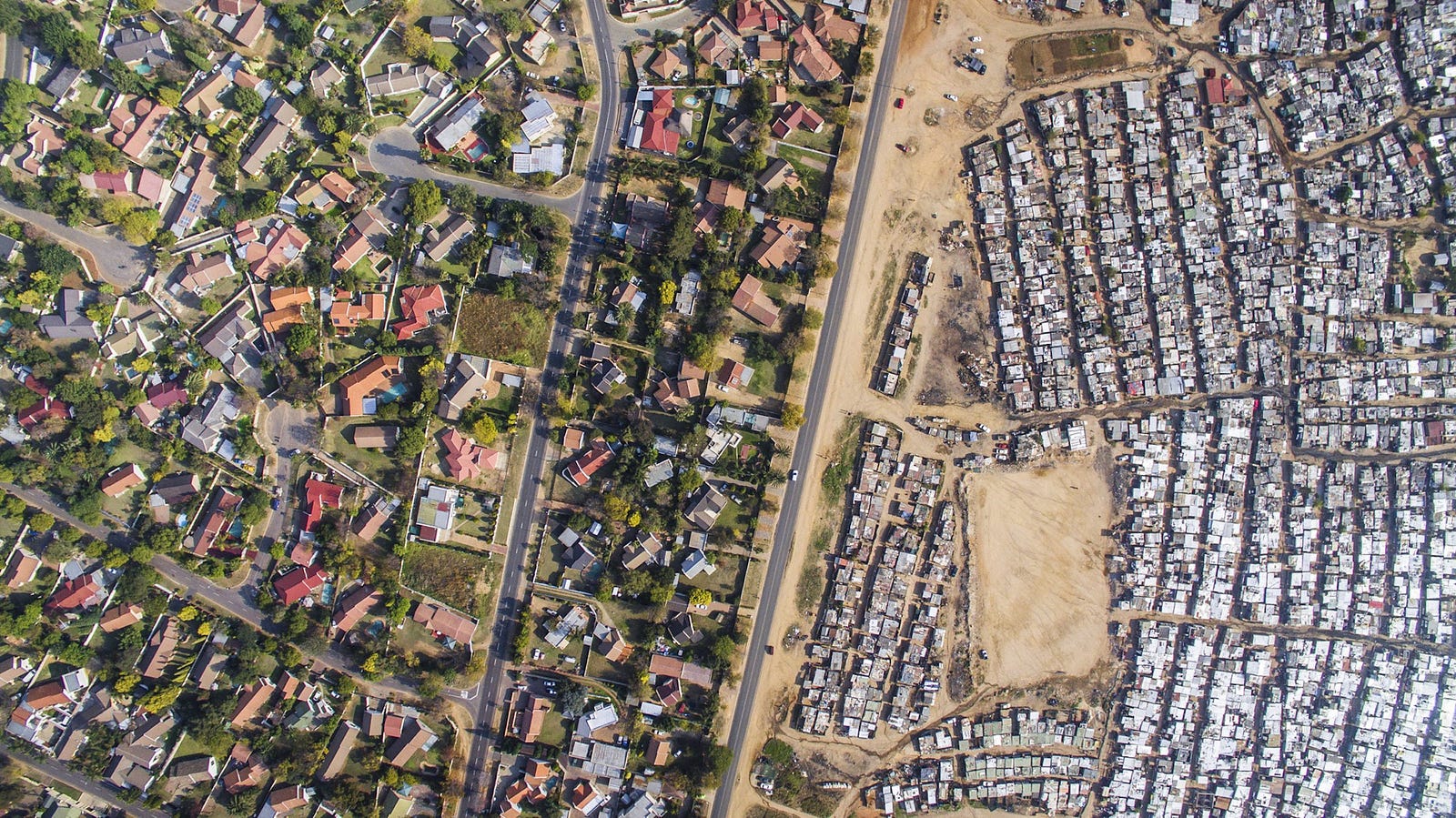
We could improve the economic performance and quality of life for everyone within our communities if we started to integrate informal settlements into the design of our cities, if we stopped choosing to develop our cities without designing for all economic classes, such wasted assets....

We could improve the economic performance and quality of life for everyone within our communities if we started to integrate informal settlements and low income housing and services into the design of our cities, if we stopped choosing to develop our cities without designing for all economic classes, such wasted assets....

See the wasted assets of our current city developments here


Monday, February 27, 2017

Free access for 50 days to new journal paper on workers' preference for working in natural environments over typical workspaces for a diverse range of work activities, by Symbiosis Principal Giancarlo Mangone


                                Worker Performance Microforest integrated into office building atrium


Elsevier is providing free access to Symbiosis Principal Giancarlo Mangone's new journal paper on workers' preference for working in natural environments over typical workspaces for a diverse range of work activities, until April 18, 2017. 64 knowledge workers in The Netherlands were found to prefer working in different types of natural environments for a diverse range of work activities. Typical work spaces were preferred for several work activities, although they were the minority. These results indicate workers prefer a more diverse range of workspaces than are currently provided in office buildings, and that nature integrated workspace types and spatial qualities can be beneficial for conducting a range of work activities, depending on the design of the workspace. These research findings support Prof. Mangone's research and work in integrating microforests into workspaces to improve occupant work performance, well-being, and happiness, while reducing their stress and providing economic benefits to building owners.

Thursday, February 16, 2017

Join Symbiosis Principal Giancarlo Mangone at the Institue of Sustainable Urbanism at TU Braunschweig, Germany at 5:30pm on Feb 21st, for a lecture on how to develop EPC sustainable communities that improve the local economy, ecology, and quality of the community in the W. European context


Join Prof. Giancarlo Mangone at the Institute of Sustainable Urbanism at TU Braunschweig, Germany at 5:30pm on Feb. 21st for a lecture and follow-up discussion on how to develop ecologically positive communities [EPC] in the Western European context, and how that compares with EPC solutions in North and Latin American contexts. Ecologically positive communities are sustainable communities that improve the local economy, ecology, and quality of the community.


Thursday, October 27, 2016

How can nature be brought into cities in ways that reduce municipal costs while providing new economic opportunities for the local community, all while improving community health + well-being, & improving local ecosystems? Join Symbiosis Principal Giancarlo Mangone's lecture + talking panel at the international Naturescene symposium at Canada's Museum of Nature Nov. 9th


Worker Performance Microforest Atrium by Giancarlo Mangone


Innovative urban nature integration design strategies can provide diverse economic, social, and ecological benefits that reduce municipal costs while providing new economic opportunities for the local community, all while improving the health and well-being of community members, as well as the health of local ecosystems. Learn about these innovative, cost effective solutions at the international Naturescene symposium  Canada's Museum of Nature on Nov. 9th during Prof. Mangone's lecture and international expert panel discussion.

This event will also feature the public release of Prof. Mangone's 'Performative Microforest' design series - Come out and join the discussion!


Thursday, September 22, 2016

Symbiosis Principal Giancarlo Mangone lectures on how to develop EPC sustainable communities that improve the local economy, ecology, and quality of the community for Ottawa Architecture Week, Friday 6pm

Giancarlo Mangone will discuss how to develop sustainable communities that improve the local economy, ecology, and quality of the community, Ecologically Positive Communities,  as part of Ottawa Architecture Week, Friday 6pm, at 55 Metcalfe St (Manulife Place), Suite 420.


Thursday, June 16, 2016

What are the maximum economic, social, and ecological benefits that can be achieved by integrating nature into cities? Symbiosis Principal Giancarlo Mangone presents the potential benefits of existing and innovative urban natural environment integration strategies at the EAEE 2016 conference in Lisbon


Existing urban natural integration strategies tend to be ineffective at generating economic, ecological, and social benefits to local communities, compared to the potential benefits that natural environments can provide. Symbiosis Principal Giancarlo Mangone presents an investigation of the potential benefits of different types of existing urban natural environment integration strategies, such as landscapes and building integrated natural environments, as well as the potential benefits of a more innovative, integrated urban natural environment type that can have substantially greater ecological value. Learn more at his presentation on June 16th at the EAEE/ARCC 2016 conference in Lisbon, Portugal

Tuesday, May 31, 2016

Symbiosis Principal Giancarlo Mangone proposes a more effective sustainable building design method and offers an innovative, highly effective sustainable building design solution in his recent journal paper, Constructing hybrid infrastructure

Building developments can be significantly more sustainable than those that are currently being developed. Moreover, building developments can play a significant role in developing sustainable communities, as well as resolving the negative global ecological impacts that human communities have on natural ecosystems that are endangering the ability of human communities to survive and thrive in the coming century. However, more innovative and rigorous design solutions are needed to achieve these goals.


Symbiosis Principal Giancarlo Mangone proposes a more ambitious and effective method for design teams to evaluate the ecological performance (sustainableness) of buildings, in his recently published double blind peer reviewed journal paper, Constructing hybrid infrastructure: Exploring the potential ecological, social, and economic benefits of integrating municipal infrastructure into constructed environments. His research indicates that incorporating municipal infrastructure systems into buildings and landscapes, as hybrid infrastructure, can be particularly effective ecologically, while providing a number of unique social and economic benefits as well.

Read more within the currently freely accessible journal publication (until July 8, 2016), via this weblink : http://authors.elsevier.com/a/1T3lqy5jORXbc


Wednesday, December 9, 2015

Symbiosis Principal Giancarlo Mangone’s new book on the performance benefits of integrating microforests into buildings is now available on Amazon.com

Symbiosis Principal Giancarlo Mangone's new book on performative microforests explores innovative research into the economic, social, and ecological performance benefits of integrating natural environments into office buildings, and describes why microforests are more effective sustainable solutions than other typical green building strategies, such as green roofs and green walls. Through both an in-depth review of existing literature and the presentation of cutting edge research conducted by the author, a diverse range of novel benefits that can be attained from integrating microforests into buildings are investigated. Integrating forests into buildings can reduce construction and operation costs, resource consumption rates, improve occupant productivity, creativity, and well-being, while also improving the health of local ecosystems. 


Microforests can help improve the economic, social, and ecological performance of buildings, occupants, and local communities.


The paperback version of this book is now available on amazon.com
The digital version of this book is now available on the TU Delft Architecture and the Built Environment's website


Thursday, October 22, 2015

Integrating forests into buildings can reduce construction and operation costs, improve occupant productivity, creativity, and well-being, while also improving the health of local ecosystems. Learn how at Giancarlo Mangone's lecture and PhD defense, Oct. 29th at Delft University of Technology


Integrating forests into buildings can reduce construction and operation costs, improve occupant productivity, creativity, and well-being, while also improving the health of local ecosystems.  Learn how the design of microforests in buildings can provide a diverse range of economic, social, and ecological benefits at Symbiosis Principal Giancarlo Mangone’s PhD lecture and thesis defense at the Senaatszaal room in the Aula auditorium, at Delft University of Technology, 12pm on October 29th.


Tuesday, April 7, 2015

Employee productivity + creativity can be improved by working in natural environments, finds a study presented at ARCC 2015 by Symbiosis principal Giancarlo Mangone


                                          Semi-outdoor courtyard designed for high worker + building performance

Diverse natural environments improve worker performance for a range of work tasks, according to a new study presented at ARCC 2015 in Chicago by Symbiosis principal Giancarlo Mangone. The results of this study indicate that current work environments are ineffective at promoting worker performance. Companies can substantially increase their profits, and improve worker well being, by incorporating innovative, higher performance workspaces. To this end, a number of natural environments have been found to be particularly effective. For more information about this research project, visit the lecture at 9:00 in the Hyatt Regency in Chicago, on April 8, 2015.


Thursday, September 11, 2014

The integration of microforests in buildings can reduce energy use + increase worker productivity, reports a new scientific journal paper by Symbiosis Principal Giancarlo Mangone

Working in a vegetated environment was found to significantly improve the participants' thermal comfort, in a quasi experiment that was published in a recent issue of the peer reviewed scientific journal, Building and Environment (click the link for a free copy of the article until Oct. 1, 2014)

The participants' thermal comfort increased even in more extreme temperatures. Thus, the integration of a microforest, or densely vegetated spatial environment, in an office building can reduce building energy use, by allowing the temperature setpoint to be raised in the summer and lowered in the winter.

The results were based on a year long thermal comfort quasi experiment conducted in 2013 with approximately 70 office workers in The Netherlands, in which half of the participants had extensive vegetation in their workspace, while the other half didn't.

The operative temperature was varied throughout each testing period (one month per season). Plants were found to significantly improve occupant thermal comfort, including temperatures that were  warmer and cooler than they were accustomed to.

The results of this research indicate that incorporating microforests into buildings not only reduces energy costs, but also can make the building more resilient to mechanical failures, peak loads, the effects of climate change, etc. Potential additional benefits include reducing mechanical equipment sizing, and increasing worker productivity and well being.
 

Tuesday, October 15, 2013

Symbiosis principal Giancarlo Mangone’s PhD research concept integrated into Schmidt Hammer Lassen's design proposal, wins Norway’s ‘Nordic Built Challenge' Design Competition

                                                    Rendering Courtesy of Schmidt Hammer Lassen Architects

The 'Urban Mountain', our design team's winning submission, was awarded first place in Norway's Nordic Built Challenge. The jury commented that the 'Urban Mountain' "merges architectural design and environmental strategies in a manner no other entry quite reaches", it "insists on setting a new standard"

In order to achieve a BREEAM Outstanding performance rating, as well as integrate nature into the performance and experience of the project,  Giancarlo Mangone developed an innovative vegetation integrated thermal chimney advanced natural ventilation and air filtration system. This system was developed from strategies and results from his ongoing PhD research at TU Delft, and resulted in the incorporation of plants to filter the interior and exterior air, as well as provide spatial natural environments. This integration of natural environments was developed in a way that improved worker creativity and productivity, energy consumption rates, indoor air quality, interior daylighting potential, occupant thermal comfort, as well as provided high performance work spaces. The project also addressed the local ecosystem's ecological integrity by providing microhabitat patches for various local flora and fauna, and raises occupants ecological awareness through the provision of opportunities for direct interaction between people and a dynamic range of local habitats and biota.  These benefits improved the economic, energy, worker, and ecological performance of the project, and resulted in an innovative, high performance design solution.

The Nordic Built Challenge asked design teams to renovate a 25 story office building in downtown Oslo, Norway. The performance goal of the competition was to develop 'the most environmentally friendly rehabilitated building complex in the Nordic Region', and set 'a new design standard with bases in economy, environmental innovation and life cycle principles, for holistic rehabilitation of an existing, high rise office building. The design proposal must address Cradle to Cradle standards, and work towards being rated as BREEAM Excellent or Outstanding.


The design team included Schmidt Hammer Lassen Architects, Symbiosis : Sustainable Design + Consulting, Transsolar Energietechnik GmbH, Cradle to Cradle Denmark, COWI DK, Loop Architects

Wednesday, July 10, 2013

Symbiosis Principal Giancarlo Mangone's PhD Research published as cover story in Dutch National Mechanical Engineering Magazine - TVVL


Symbiosis Principal Giancarlo Mangone was invited to write an industry article on his PhD research for the Dutch National Mechanical Engineering Organization TVVL's magazine. The article was featured as the cover story of the June 2013 edition of the magazine. The research project is focused on how the design of buildings can improve the performance of building environments, with particular focus on how to design building projects to minimize building energy use and construction and operating costs, as well as improve the space efficiency of the building, occupant creativity and comfort, and the ecological integrity of the local ecosystem. 
 
High performing solutions to these problems are developed and evaluated in this research project through the design of microforests within existing buildings and new construction projects. By integrating natural environments and processes into buildings and building infrastructure systems, previously unachievable performance benefits are achieved. To find out more, read the article here

Wednesday, August 22, 2012

Symbiosis principal Giancarlo Mangone to present high performance building design and performance evaluation system at World Green Roof Congress 2012 in Copenhagen


 Symbiosis principal Giancarlo Mangone will present the company's developing high performance building design and performance evaluation system at the World Green Roof Congress 2012 in Copenhagen, on September 20, 2012.
 
This innovative design support system will be explained through a presentation of a case study Symbiosis generated for a developer in Amsterdam. Using a renovation for a typical existing, mid-size Dutch commercial office building, the performance and applicability of this design support system was evaluated.


Design solutions that improved the performance of the project in a myriad of performance parameters were developed, including economic performance, worker performance, and ecological performance. A standardized performance chart, along with more detailed text guidelines, was developed for each design solution. These tools offer a method to compare the performance of the design solutions, which provides design teams with the opportunity to effectively and efficiently determine which design solutions and strategies are most suitable for their project. Thus, design teams, developers, and building owners can utilize this toolkit to make informed design decisions that result in higher performing buildings, improved employee performance and comfort, and improved local biodiversity and ecoligical integrity

In the Netherlands, 14% of existing office buildings are vacant. 60% of these buildings remain vacant for more than three years, thereby becoming out-dated and unable to provide adequate work environments for prospective tenants.
By renovating existing office buildings with the shared goal of improving local biodiversity, building performance and costs, company revenues, and worker performance and comfort, the performance of each of these project parameters can be improved, while providing more appealing and accommodating office spaces.
 
Attend the conference in September to learn more about how to reduce building costs, increase company revenue, improve worker performance and comfort, and improve the local ecosystem through architecture.

Thursday, May 24, 2012

Giancarlo Mangone guest critic for design studio in the Umea School of Architecture in Sweden


Symbiosis principal Giancarlo Mangone will be a guest critic for design studio reviews in the  Umea School of Architecture in Sweden. The school curricula is focused on integrating sustainability, research, and aesthetics, in an experimental, and innovative manner. 

Wednesday, May 9, 2012

Can Investing in and designing for Nature Stimulate the Economy?

Symbiosis Research Question of the Week : Can Investing in and designing for Nature Stimulate the Economy?

Over the years, Symbiosis has taken on various research initiatives to identify methods to improve local economies through the construction of natural environments. The primary design driver in this research has been : Can architecture be non - anthropogenic (not designed primarily for human occupation and direct use) and still improve local economies, ecosystems, and communities?

The Guardian reported an inspiring example, that although not currently engaging the field of architecture, has developed methods to stimulate local economies while improving local ecosystem biodiversity and ecological integrity. By constructing a 'forest wall' across the border of the ever-expanding Sahara desert in Africa, local ecosystem biodiversity and integrity is improved, while providing agricultural resources for local communities, reduce the local desertification process, 20 years in the making, this project now has global financial support, and is set for construction.


So the question is, how can architecture engage this concept?

Tuesday, March 27, 2012

How can buildings enhance and protect occupant health and performance?


High Performance Office Building, designed by Symbiosis

Symbiosis Research Question of the Week : How can buildings enhance and protect occupant health and performance?

The environments people occupy have a significant, direct  effect on their health and well-being. The average person in the US and Europe spends around 90% of their time indoors. Current building environments frequently generate illnesses and negatively impact people's health, well-being, and work performance, through Sick Building Syndrome, other Building Related Illnesses, and non-stimulating environments. Poor air quality, toxic materials, and disconnect from natural stimuli such as natural daylight, plants, and local climate conditions are among the contributing factors. In addition, current research by the Biology and Built Environment Center indicates that typical mechanical ventilation strategies meant to improve air quality are having the opposite effect, removing the beneficial bacteria and matter (which generally originate in the natural environment) from the air, and replacing it with detrimental matterincluding human sweat, saliva, and VOC's. 

How can buildings be designed to enhance and protect occupant health and performance?

Symbiosis, in collaboration with Wageningen's environmental psychology ' Health and Society ' chair, is developing a building health performance evaluation tool and guidelines for designers.


Check back in for future results

Wednesday, March 7, 2012

Symbiosis high performance design process published in book, Aesthetics of Sustainable Architecture


Symbiosis principal Giancarlo Mangone's book chapter describing his innovative, performance based design process , "Constructing Sensuous Ecologies : Looking beyond the energy + carbon efficiency arguments" published in the book, Aesthetics of Sustainable Architecture, edited by Sang Lee.


Now available for purchase on  amazon.com  and 010 publishers

Symbiosis joins The Green Collective biodiversity network

Symbiosis joins The Green Collective network to collaborate on developing solutions to sustain biodiversity at the building, urban, and national scale in The Netherlands.

Friday, March 2, 2012

How can buildings improve local biodiversity?

Symbiosis research question of the week : How can individual buildings be designed to improve local biodiversity while improving building and occupant performance?